Peter De Wetter
Historical Summary
Herman Peter de Wetter-Rosendahl, born in New Rochelle, New York, on January 28, 1920, was honored by the El Paso County Historical Society in 1996 for a lifetime of military, business, and civic leadership closely tied to El Paso. Educated first by a tutor and later at Salem School in Germany and Phillips Exeter Academy, he experienced the hardships of the Depression before beginning work in retail and manufacturing in the northeastern United States.
After the attack on Pearl Harbor, de Wetter enlisted in the U.S. Army, rose from private to lieutenant through Ordnance Officers' Candidate School, and was sent to Fort Bliss, where he met Mardee Belding of El Paso; they married on August 7, 1943. Following Army Intelligence School, he served in Europe during World War II, taking part in the Normandy invasion, the liberation of Paris, the Battle of the Bulge, and the invasion of Germany, and he entered Buchenwald on the day of its liberation. He earned five battle stars and the Bronze Star and returned to El Paso in 1945 as a major.
In postwar El Paso, de Wetter worked in retail before entering business ownership, including Sunland Venetian Blind Manufacturing Company and OK Van and Storage Company, which became a Bekins agent. He later led El Paso Terminal Warehouses and built a reputation as an energetic executive. At the same time, he became deeply involved in civic life, serving in leadership roles with the El Paso Chamber of Commerce, Goodwill Industries, St. Clement's Episcopal Church, Rotary, the Rio Grande Girl Scout Council, and several state commissions and boards under Governors Preston Smith and John Connally.
Elected mayor of El Paso in 1969, de Wetter emphasized civic responsibility, housing reform, and inclusive leadership. His administration accelerated public housing construction, enforced the city housing code, and helped end racial discrimination in housing. He also helped secure the El Paso Job Corps Center after direct intervention in Washington, strengthening local workforce training. Under his leadership, El Paso was named a 1969 All-American City by Look magazine, which credited the city’s “spiritual awakening” and reform efforts.
De Wetter also strengthened relations with Ciudad Juárez through regular cooperation with Mayor Bernardo Norzegaray and played a key role in financing and contracting for El Paso’s new Civic Center. After his mayoral term ended in 1971, he moved to Los Angeles to become executive vice-president, and later CEO and president, of Bekins. He remained active in public speaking and civic service, serving numerous California charitable, educational, and business organizations and sitting on the boards of major corporations including Mattel, Thomas J. Lipton, Lawry’s Foods, Beneficial Standard, and National Medical Enterprises.
In 1979 he joined National Medical Enterprises as executive vice-president and retired in 1989 while remaining on its board. He and Mardee then returned to El Paso, where he resumed extensive civic work, including leadership in housing development, the Visiting Nurse Association, the Rio Grande Food Bank, the University of Texas at El Paso, the University of the Americas Foundation in Puebla, and the El Paso Museum of Art. His honors included national awards from Goodwill Industries, the National Conference of Christians and Jews, and the Alzheimer’s Association, as well as El Paso’s Conquistador awards and the University of Texas at El Paso’s Grand Paseño Award.
Alongside his public service, de Wetter and his wife supported El Paso through philanthropy, including endowments for creative writing and library collections at UTEP. The tribute portrays him as a decisive wartime officer, successful executive, reform-minded mayor, and enduring civic benefactor whose leadership left a lasting mark on El Paso’s development and public life.
Document Transcription
Hall of Honor, 1996
Tribute to Peter de Wetter
By Gertrude A. Goodman
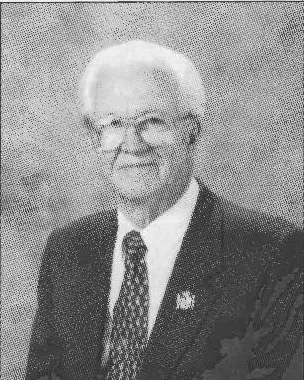
Peter de Wetter
Photo courtesy El Paso County Historical Society
Tonight the El Paso County Historical Society is honoring two very special and distinguished gentlemen. It is a privilege and honor for me to present this tribute to Peter de Wetter, a charter and lifetime member of this society.
It is difficult to cram Peter's seventy-six years of extraordinary living into a few minutes. Peter is a natural leader—an outstanding individual of character, courage, vision, and creative spirit. He fits every requirement for this honor. Peter de Wetter is almost a household name. Peter was born Herman Peter de Wetter-Rosendahl, on January 28, 1920, in New Rochelle, New York. His father, Herman, a civil engineer, and his mother, Louise, had two daughters, Noël and Mary, before their only son, Peter, was born.
Peter's first education was provided by his tutor, Michael Martin. Later, when his father was a civil engineer for an American company in Berlin, the family lived in Germany where, at the age of seven, Peter was sent to Salem School on the German side of Lake Constance. This renowned school, which still exists, was founded by Kurt Hahn, the famous educator who later developed the Outward Bound programs based on his tenets. This training for survival has helped Peter throughout his life.
During the Depression, the de Wetter family, suffering from genteel poverty, returned to the United States. Peter graduated from Phillips Exeter Academy in 1939. His first full-time job was as a stock boy at New York's Macy's Department Store where he earned $60 a month. Later, he was employed by J.C. Penney as a management trainee. His salary increased to $75 a month. Even later, in Meriden, Connecticut, he worked as a production manager for a foundry, the Charles Parker Company. He was there in 1941 when the Japanese bombed Pearl Harbor.
One month later Peter enlisted as a "buck private" in the United States Army. After infantry basic training, he was selected to go to Ordnance Officers' Candidate School—graduating as a lieutenant. That is how Peter found himself on a flatcar of a train headed for Fort Bliss, Texas! His sister Noël had given him the names of two El Paso friends whom she had met when they were attending summer school at the National University of Mexico in Mexico City. One was Mardee Belding. A week after meeting, Peter and Mardee became engaged. They were married nine months later on August 7, 1943.
After attending Army Intelligence School, Peter was sent to Europe. He participated in the Normandy invasion, the liberation of Paris, the Battle of the Bulge, and the invasion of Germany. He entered the Buchenwald Concentration Camp the day it was liberated, an experience he has not forgotten.
Peter earned five battle stars and the Bronze Star. In 1945, he retired as a major and returned to El Paso and his wife, Mardee.
His first El Paso job was at the White House Department Store. Then the de Wetters lived for a short time in Colorado Springs, Colorado. When they returned to El Paso, Peter and his partner, Newell Hayes, purchased the Sunland Venetian Blind Manufacturing Company. In 1952 they purchased OK Van and Storage Company, Inc. Peter served as CEO and president and later bought out his partner. OK Van became an agent of Bekins, and Peter served on the Advisory Board of Directors of Bekins. In addition he was president of El Paso Terminal Warehouses from 1964 to 1971. His partners were Gordon Foster and Robert Cutler. As we all know, Peter never sits still. He always is on the move.
During these years in El Paso, Peter was involved in many civic endeavors. He served as president of the El Paso Chamber of Commerce and was elected Civil Service Commission chairman. He was president of the Goodwill Industries of El Paso in addition to serving as a member of the National Goodwill Board. He was on the Vestry of St. Clement's Episcopal Church and a member of the Rotary Club of El Paso. Governor Preston Smith appointed him to serve as chairman of the Far West Texas Committee to urge passage of the Texas Water Plan. Later Governor Smith appointed him as a member of the Texas Urban Development Commission. Governor John Connally appointed Peter to serve on the first nine-member State Board of Mental Health, Mental Retardation. Peter was president of the Rio Grande Girl Scout Council. His speech to the National Girl Scout Convention in St. Louis put El Paso "on the map" and gave Peter his first national exposure.
Peter does not merely lend his name to an organization. He always is an active participant. He rolls up his sleeves and works!!
In 1969, at the age of 49, Peter was elected mayor of El Paso. He pledged responsible and responsive leadership with dedication to civic commitment rather than political ambition. He was a mayor with compassion for his fellow El Pasoans. He reached out to all segments of the community with the intent of improving El Paso.
Peter accelerated the construction of new public housing and began to enforce the city's housing code. His administration, which included aldermen Bob Hoy, Tony Petry, Sal Berroteran, and Clinton Wolfe, was responsible for ending racial discrimination in housing.
The day after Peter took office, he received a telegram from the Moody Foundation of Texas which stated that El Paso might be given a Job Corps program which originally was destined for San Antonio. Peter and Joe Aguilar immediately went to Washington, D.C., to see the Secretary of Labor, George Romney. This visit resulted in the establishment of the El Paso Job Corps Center which, unlike some other programs, trained its corps members for special skills needed here in El Paso. Incidentally, for seventeen years this center, now known as the David Carrasco Job Corps Center, has been "number one" in the country. Mary Young, the present center director, and some members of her staff are present tonight.
The March 10, 1970 edition of Look magazine reported that an astute jury selected El Paso as Look magazine's "All American City for 1969." To quote the magazine:
El Paso, Texas—The largest 1969 winner (population 350,000) has so far accomplished least in brick and mortar terms. A new special care hospital supported by $650,000 in citizen donations is being built. The first low-cost housing in 16 years and a Labor Department manpower training center are on the way. But El Paso's true All American claim is staked upon its spiritual awakening, led by Peter de Wetter, a peppery businessman.
In the January 1985 edition of Columbian Monthly, Hawley Richeson wrote about El Paso in an article entitled "The Best Place to Live:"
One council, with vision and leadership, has been hailed for creating a five million dollar model housing project for low-income families. Approval for the project was assured when Peter de Wetter, then mayor of El Paso, supported it saying, "it is my considered opinion that programs of this type will improve the quality of living in El Paso and will be followed by similar programs to benefit all El Pasoans."
Peter worked hard to cement, broaden, and improve relations with Ciudad Juárez. He met regularly with Mayor Bernardo Norzegaray, who later wrote, "A testimonial to Peter in recognition of the close cooperation—both practical and spiritual—during the time Peter served as mayor." Peter sold bonds in New York for financing the new Civic Center and signed the contracts for it with the architects and contractors. He insisted on the finest acoustics available.
In 1971, when his term as mayor ended, Peter accepted a business opportunity to serve as executive vice-president of the Bekins Company with headquarters in Los Angeles. Later he became CEO and president. Like Richard Bach's story, Peter was a soaring Jonathan Livingston Seagull. During this time Peter, always articulate, spoke to countless groups. His speeches were quoted in newspapers throughout the country. He always referred to the political experience he gained as mayor of El Paso and he urged businessmen to become involved in politics.
He was a down-to-earth executive! Once Peter decided to take a first-hand look at what his Bekins drivers had to cope with in their daily routines. Donning a Bekins uniform, he went on the road for a week, incognito, from Chicago to the West Coast. His experience was noted in many national publications.
He worked untiringly in civic endeavors in California. These included the boards of United Way, Boy Scouts, National Goodwill Industries, the National Conference of Christians and Jews, the French Foundation for Alzheimer's Research, and the advisory board of the Los Angeles Chapter of the American Heart Association. He was a trustee for the Claremont School of Theology, the City of Hope, and the Orthopedic Hospital. He was a director of
HALL OF HONOR
the Los Angeles Chamber of Commerce, the Music Center Operating Company, the Metropolitan YMCA, and was on the Board of Directors of the Rotary Club of Los Angeles. He was honored by the City of Hope and the National Conference of Christians and Jews in Los Angeles.
In addition, he was on the Board of Directors of the Merchants' and Manufacturers Association and served as a member of the Board of Directors of eleven corporations, some of which were Thomas J. Lipton, Mattel, Beneficial Standard Company, Lawry's Foods, and National Medical Enterprises.
In 1979 Peter left Bekins. He then was elected executive vice-president of National Medical Enterprises, a world health provider. In 1989 Peter retired from National Medical but remained a member of its Board of Directors.
Always loyal to their beloved El Paso, Mardee and Peter returned home.
Still a powerhouse of energy, Peter immersed himself in community affairs. He is chairman of the Greater El Paso Housing Development, a non-profit corporation under the Chamber of Commerce. He was co-chairman with Susan Mayfield of the Visiting Nurse Association capital campaign, a board member of the Rio Grande Food Bank, a member of the University of Texas at El Paso Development Board and chairman of its Endowment Committee, trustee of the University of the Americas Foundation at Puebla, Mexico, member of the advisory board of the School of Fine Arts, University of Texas at Austin, on the Chancellor's Advisory Committee of the University of Texas System, and an active member of the Rotary Club of El Paso. He still serves on the Board of Directors of Tenant Health Care System, formerly National Medical Enterprises. Being a seasoned management consultant, Peter served pro bono for one year as interim director of the El Paso Museum of Art. He is one of the prime movers in the campaign to relocate the museum to the downtown location.
Peter's honors are numerous. He was presented distinguished awards from three national organizations: the National Goodwill Industries; the National Board of the National Conference of Christians and Jews; and the National Board of the Alzheimer's Association. He received two Conquistador awards from the City of El Paso. Most recently, he was surprised when President Diana Natalicio presented him with the University of Texas at El Paso Grand Paseño Award, the highest honor the University can bestow on a non-alumnus. Peter is a lifetime member of the Sons of the American Revolution, the Order of the Cincinnati, and the Order of the Crown of Charlemagne.
Mardee and Peter have been generous supporters of El Paso. Recently they established two significant University of Texas at El Paso endowment funds, one to support a chair for creative writing and the other to augment the library's book collections.
Peter is not all business. He is genial and just plain human, with a keen sense of humor. Years ago, when Peter was recuperating from pneumonia, I gave him a well-known book. Since it was slightly off-color, I punched holes in the upper right-hand corner of each page and put a lock through the holes so no one could turn the pages. Peter returned the lock, but kept the book, which he obviously enjoyed.
In spite of his busy lifestyle, Peter never neglected his family or his friends. He is loyal and thoughtful to friends from every walk of life all over the world, especially here in El Paso. The de Wetters are a devoted family. Mardee and their sons have supported Peter in all of his endeavors as he has in all of theirs.
It is difficult to talk about Peter without including Mardee in every statement. Truly, they are a team. I must add that Mardee is a fourth-generation El Pasoan. She was the daughter of Betty Safford and Charles Delap Belding and the granddaughter of Dr. and Mrs. Henry Safford, all prominent in El Paso's history. The de Wetters have three sons: Charles, now living in El Paso with his wife, Lori, and their three children, Lauren, Noelle, and Peter, the younger; David Brooks, a professor living in Westport, Connecticut; and Dr. Robert de Wetter and his wife, Regina, of Sewanee, Tennessee, where he is a seminarian at the Episcopal Seminary of Sewanee. Peter's nephew, Dr. Keir Sterling of Richmond, Virginia, is present for this banquet tonight.
Peter has defied the Peter Principle by excelling in whatever he attempts. His contributions to El Paso have been enormous and have influenced the course of history in El Paso County. He has promoted and brought honor and recognition to El Paso.
Peter, for having lived here, has made El Paso a better place and well deserves induction into the El Paso County Historical Society's Hall of Honor.