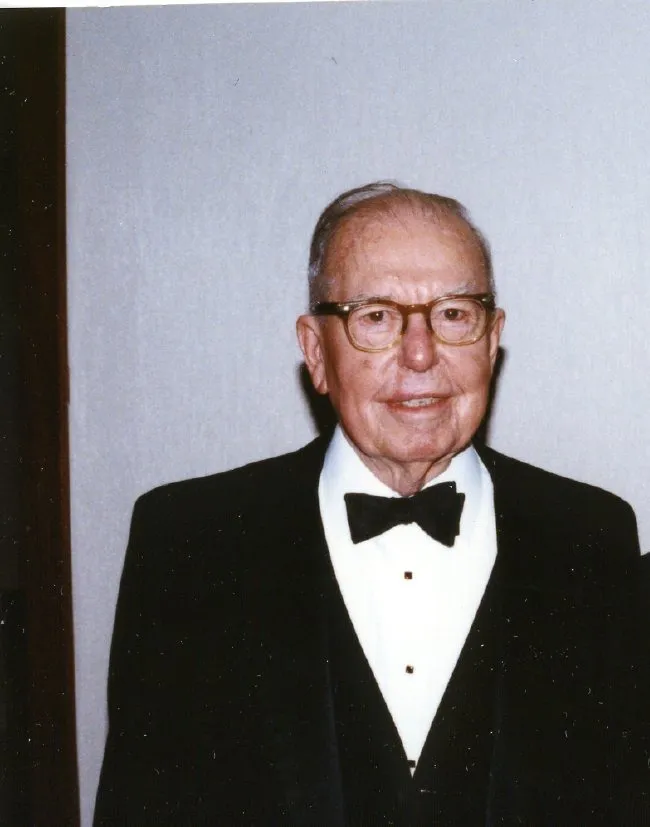
Tom Lea
Historical Summary
James Price Hague is presented as one of the formative figures of early El Paso, celebrated for twenty-six years of leadership in the city’s cultural, legal, and business life. Owen White praised him as among the most brilliant men of the Southwest, and he is honored as a builder of both the material and spiritual foundations of El Paso, culminating in his induction into the El Paso County Historical Society Hall of Honor.
Tom Lea is honored as a native El Paso artist and writer whose life and work were deeply rooted in the borderland landscape and history of El Paso del Norte. Born in 1907 to attorney and former El Paso mayor Tom Lea Sr. and Zola Mae Utt, he was shaped by local schools, influential teachers, and early artistic training before studying at the Art Institute of Chicago, where he developed as a painter and worked under muralist John Norton.
After returning to the Southwest in 1933, Lea endured personal losses, including the death of his wife Nancy and close family members, while establishing himself as an independent artist in El Paso. He gained recognition through federal mural commissions such as “The Nesters” and “Pass of the North,” and became closely associated with regional literary and artistic circles, collaborating with J. Frank Dobie and Carl Hertzog, illustrating books, writing poetry, and painting murals for public institutions.
Lea’s career expanded nationally and internationally during World War II, when he served as Life magazine’s first war artist assigned to battle zones. His powerful depictions of combat in the Atlantic, Pacific, North Africa, Italy, China, Burma, and India, including work from Peleliu, established him as a major visual chronicler of war and deepened the humanistic perspective that marked both his art and writing.
In the postwar years, Lea achieved major literary success with The Brave Bulls, followed by works such as Wonderful Country, The Primal Yoke, and The Hands of Cantú. He also wrote historical works connected to ranching and the American West, including books associated with King Ranch and Australia. The tribute emphasizes not only his artistic and literary genius, but also his humility, discipline, civic importance, and enduring partnership with his wife Sarah, portraying him as a central interpreter of the history, landscape, and heritage of the Southwest.
Document Transcription
150
Mrs. Charles A. Goetting
To read of early El Paso is to read of James Price Hague, an unusual man of vision, whose name and deeds form an integral part of the cultural, legal, and business life of bygone days. In his book Out of the Desert, Owen White, our earliest historian, says of Judge Hague:
In studying the character of early El Pasoans and in going back as far as I can in my personal recollections of them, I find no one who is more worthy of consideration than is James P. Hague. I can recall that, as a child, I frequently heard my father and other men speak of Hague as the most brilliant man in the Southwest. His record, as I find it, justifies the appellation. For twenty-six years he took a leading and aggressive part in the life of El Paso and made for himself a reputation as a citizen and lawyer which places him in the very front rank of those who have left their mark upon the pages of the history of this city.
Our beautiful El Paso is a monument to such men and women. Those of us who have lived a lifetime here view this with the realization that they built up not only a material El Paso but a spiritual structure: to quote Owen White, “an Americanism, far-seeing, determined. This spiritual legacy is the richest part of our inheritance.”
James Price Hague embodied these qualities of character, and we salute him as his name is placed in the El Paso County Historical Society Hall of Honor tonight.
TRIBUTE TO TOM LEA
by CHARLES H. LEAVELL
Mr. Chairman, members of the Historical Society, distinguished guests:
Tom Lea has been my true friend and I a friend to him since early manhood. Yet our love and respect for one another is even stronger because our wives, Sarah and Shirley, share the same deep friendship. Hence it is a rare privilege for me to introduce to you a distinguished citizen of our great city, who in truth is a humble hometown boy. . . . .
A native son of the city of El Paso, Tom's life and art have thrived in the sun-burned realm beneath our mountain, the distinctive earthmark of the country where Tom Lea belongs both in imagination and in creative reality; he has roots here.
These roots began at the turn of the century when his mother's family, the Joseph Utts, moved to El Paso for health reasons, and his grandfather built a rooming house at 811 North El Paso Street. His mother, while gaining her high school education in the El Paso Public Schools, helped with the work in the Utt rooming house.
Tom's father, also named Tom, a young lawyer from Independence, Missouri, on his way to Grand Junction, Colorado, to practice law, landed in El Paso as a result of a misfortune. He had lost his wallet with all his cash during a stage stop near Alamogordo. Then, in the true style of Tom Lea Senior, he persuaded a railroad conductor into giving him a ride to El Paso, without a ticket!
151
Tribute to Tom Lea
Here in El Paso he soon found a job and met and won the hand of the beautiful Miss Utt. Before they were married, the young lawyer Tom Lea made a number of adventurous trips into the interior of Mexico, as a mine-seeker. None of these quests were successful, so he returned to El Paso, set out his shingle as a practicing attorney, and married Miss Zola Mae Utt in June of 1906. Then for almost forty years he ably practiced law here in El Paso. His firm, Lea, McGrady, Thomason & Edwards, is still remembered and respected wherever lawyers of the Southwest gather. Active in local politics, the senior Tom Lea served as Mayor of El Paso for one term—1915 to 1917.
The young Tom Lea was born at Hotel Dieu here in El Paso in 1907. Two other sons were born to Tom and Zola Lea, Joe in 1910 and Dick in 1927. They have forever been a close family.
Tom attended Lamar School, then El Paso High School, where he learned well the structure of the English language and the grandeurs of its literature, under the tutelage of Jeannie M. Frank. Another gifted teacher at El Paso High, Miss Gertrude Evans, contributed much to Tom's training as a painter in her classes at El Paso High.
Our honoree was seventeen when he left El Paso to enroll as a student in the Art Institute of Chicago. By this time his aims had formed. No indecision whatsoever clouded his desire to be an artist, a good one. And his parents approved! They made available the funds for his first year at art school, and with loving confidence in him, put him on the Golden State Limited to Chicago in September 1924.
As he is today, Tom went to Chicago with an eager, wholehearted enthusiasm for the work he wanted to do; he was a natural from the very beginning. There he learned to create in art the anatomy and construction of the human figure—and later of horses and cattle. There his draftsmanship carried a sureness and clarity of line which identifies his work to us today.
As Tom grew in knowledge he showed a creative preoccupation not only with the form and structure of the visible world, but with the character and performance of his fellow beings inhabiting that world.
He was becoming—which indeed he is today—a humanist, in the classic sense of that term.
John Norton, the well-known Chicago mural painter, became Tom's painting instructor at the Art Institute. Later, in February 1927, Tom became an assistant to the Maestro in his mural studio. Steady and well-paid employment in John Norton's studio made it possible for Tom to earn a living in the Depression; it was even adequate to give him funds allowing travel and study in Italy with his lovely wife Nancy, a student at the Art Institute, whom he had married in 1927.
152
Charles H. Leavell
Yet from the very beginning of his association with Norton, Tom knew that an artist, to be worthy of that name, must some time launch his own craft and set out alone on his own voyage of discovery. So, in January 1933, with $900 savings sewed in his undershirt, he and Nancy took the Golden State Limited for El Paso, his home country. It was a hard road for Tom and Nancy. After building a one-room adobe house on top of a hill south of Santa Fe, Nancy became ill and died in an El Paso hospital two years later. That same year, 1936, Tom lost his mother and grandmother. And also that same year, Tom opened a studio in the Mills Building in downtown El Paso, where he began to record by brush and pen his heritage, his home place at El Paso del Norte.
Tom as an artist describes our land as a “thirsty, bare and mostly empty country. It is tan, not green, it has no abounding grace of fertility and little softness to evoke ease in man's spirit. Its richness is space, wide and deep and infinitely colored, visible to the jagged mountain rim of the world—huge and challenging in space to evoke huge and challenging freedom.”
Under national competition he won the commission to paint an important mural for the Post Office Department in Washington. I have seen it many times. There he painted a plowman breaking dry bare earth. Standing by the furrow is his young wife, looking at the motionless windmill, at the homesteader's shack where they live, at the empty horizon; it is called “The Nesters.”
Tom went on to create other murals, always under competition (he lost a few, I might add!) to the Section of Fine Arts, Treasury Department. One you will recognize is “Pass of the North,” in the El Paso Federal Court House, in which is inscribed:
“O Pass of the North now the old giants are gone, we little men live where heroes once walked the inviolate earth.”
Then one day to his studio came Tom's father, accompanied by an unusual man—Frank Dobie. After Tom's father had left, the two remained to speak of their work, their philosophies. Unknowingly they were planning their work together. By late that night they were talking about pictures that should be in a new book and whether or not Apache Gold and Yaqui Silver had the right sound for a title.
Tom went on to illustrate the vivid Dobie books, to write the mystical poem “Randado,” to do story illustrations for Saturday Evening Post, to work with his renowned friend Carl Hertzog in designing and producing beautiful books in limited editions, to decorate the walls in murals of our Public Library.
153
Tribute to Tom Lea
But it was during the painting of the El Paso Federal Court House mural that Tom's greatest blessing occurred. He met Sarah Catherine Dighton, a visitor from Illinois. Tom won in his courtship, which has given El Paso not only a beloved couple, but in Sarah one of our outstanding leaders in our civic, social, and cultural life. Their son Jim and their two lovely grandchildren have been a blessing to their life. In 1941, when World War II loomed over the horizon—even the desert horizon along the Rio Grande—Tom left to become Life's first war artist on assignment to a zone of battle. He was on a destroyer in the North Atlantic at the time of Pearl Harbor—and he stayed with Time-Life for the duration. We are all familiar with his vivid but tragic depictions of war in the South Pacific, the Arctic, North Africa, Italy, China, Burma, and India.
He landed with the Marines at the bloody battle of Peleliu. The resulting works are installed permanently in the Pentagon.
It was during these times of trial that I became his friend. Shirley and Sarah found a deep compassion. Tom would return weary of spirit to tell me of the futility of war but of the bravery or even abject fear of the men and women who had to fight.
It was during that period when I realized that the war was having a most powerful impact upon Tom's point of view. I knew that during his prolonged war travels from El Paso he was seeing the vastness and the variety of the whole wide world, and seeing his homeland, when he returned, in new perspective!
After the war, Tom's next project was one to depict the beef cattle of America, when his attention was focused on a different kind of bovine—the fierce thoroughbred fighting bull of Spain. Though Life's editors did not approve, Tom on his own did a series of drawings and a text on bulls born to fight, and the men who chose to fight them in the plazas on Sunday afternoons.
When Tom's employment with Life Magazine terminated, he spent eleven months at work on a novel. The Brave Bulls was the result.
It became a best seller, brought the author a new kind of acclaim, and plunged him into a new career.
It was during this creative time of his life that Tom and I took our wives and packed deep into the Wind River Mountains of Wyoming. Our trails were unblazed, we slept on the ground, we fished for the wily golden trout. These were arduous trips when the Leas and the Leavells each needed the other. Sometimes we slept four or five in a tent. You really get to know a couple under those circumstances!
We went on to fish the high mountain rivers of the Argentine, to visit the ranches of the pampas. Then later we penetrated the vastness of Alaska and fished the waters of the Tik Chik Lakes and Rivers. It was always an adventure, but even more so to see the strange lands through Tom's eyes.
154
Charles H. Leavell
So now I am up to modern times. Tom's books, the popular Wonderful Country, followed by The Primal Yoke, then the pristine The Hands of Cantú, a story of the horse and its place in the exploration of North America, are well known to us all.
Bob Kleberg of King Ranch fame persuaded Tom to write the story of his ranch empire. This relationship between two strong men also created In the Crucible of the Sun, a history of Kleberg's conquest of the ranch lands of Australia.
Bob is gone now but his creative life is brilliantly recorded by Tom in pictures and in prose.
And so, tonight, we are here to honor Tom Lea and his devoted wife Sarah, his critic and his pal.
Of Tom, his friend Elliott Stevens has said:
“In the past 53 years of a close friendship with Tom Lea it pleases my heart and soul to see this honor bestowed upon him. After these many years, I still look on both his paintings and writings with undiminished delight since both symbolize our heritage.”
And his brother Joe has said:
“Congratulations to Tom on this latest of well-deserved honors, awarded in recognition of his talents, God-given perhaps, but mainly developed through his devotion for hard work and discipline, respect and loyalty to those principles which have been so much his life. It is an honor for me to call him my best friend—and brother.”
Also Dr. Harry Ransom of the University of Texas has said:
“The most obvious, but one of the less important, facts about Tom Lea is that he is a genius. He is also a great man, a citizen of our whole world, and a truly great human being. By his talents and his understanding he has encouraged countless people to know the past, to be aware of a vital present, and to hope for the future. In return for all the good he has done we can give him only the simplest of gifts, our deep and steadfast gratitude.”
Yet Chancellor LeMaistre of the University of Texas has said:
“Few men in the history of the arts have approached the undeniable visual and narrative genius that has been demonstrated by Tom Lea. His contribution enhanced the flavor and changed the atmosphere of the western heritage to which we are all so devoted. A gentle and humble man, his masterful work will be forever loved and appreciated”
Tribute to Tom Lea
by both the casual historian and the serious scholar of pen and brush.
155
An honorary Doctor of Literature from Baylor University and of Letters from S.M.U., Tom has won high literary awards for his novels. His art works are treasures of universities, of museums, and of collectors, yet Tom says of his work:
"I do know and state what my pictures are intended to be: not exercises in aesthetics or performances for the sake of technique, but records and representations of experiences in life.
I wish they could express my thanksgiving at morning, when I open my eyes and another day stands waiting."
Friends, with a warm and full heart I give you Tom Lea—