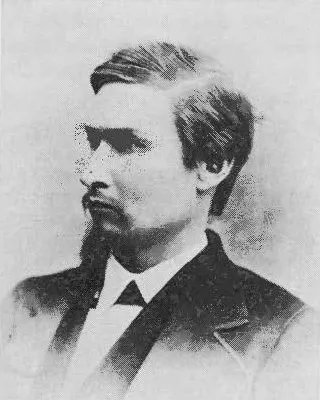
James Price Hague
Historical Summary
James Price Hague, born in Missouri in 1848 and educated at McKenzie College, came to Franklin, later El Paso, in May 1871 as the newly appointed district attorney for El Paso and Presidio Counties. Arriving in a frontier settlement of only a few hundred residents after a dangerous twenty-six-day journey from Austin, he quickly established himself as an honest and capable lawyer and public official, serving in succession as district attorney, county attorney, district judge, city attorney, and alderman before and after the age of thirty.
Hague became one of the central builders of early El Paso’s legal, civic, and economic life. He settled his family in one of the city’s notable early homes, helped organize the El Paso Real Estate and Immigration Company, and acquired substantial land, often in payment for legal services. His most consequential achievement was his long campaign to bring the Southern Pacific Railroad through El Paso. Convinced as early as 1871 that the city’s future depended on the railroad, he helped negotiate its arrival and deeded a large share of the land needed for the right of way and station. When the railroad reached El Paso on May 26, 1881, he delivered one of the principal speeches celebrating the event, which marked a turning point in the city’s growth.
As El Paso expanded, Hague remained a leading figure in municipal affairs and public reform. He served as city attorney and later as alderman, earned a reputation for courtroom skill and professional ethics, and played a decisive role in exposing the 1885 “court house steal,” a county corruption scandal in which he trapped bribery attempts and helped secure prison sentences for the offenders. He was also connected to the city’s broader development through business and journalism, including ownership in The El Paso Times.
Though nominated for Congress in 1888 and for state attorney general in 1890, Hague’s Republican affiliation and declining health prevented electoral success. He died in 1895 at the age of forty-seven, leaving a reputation, echoed by later historians such as Owen White, as one of the most brilliant and influential figures in early El Paso history. The tribute presents him as a visionary whose work shaped the city’s legal institutions, transportation links, and civic character, and whose memory was honored by the El Paso County Historical Society.
The document then turns to a tribute to Tom Lea by Charles H. Leavell. Lea is introduced as a native son of El Paso, a distinguished artist and writer deeply rooted in the landscape and culture of the region. The surviving portion emphasizes his lifelong connection to the city through both his parents’ early arrival in El Paso and his family’s place in its community life.
Document Transcription
TRIBUTE TO JAMES PRICE HAGUE
by Mrs. Charles A. Goetting
Let us go back over a hundred years to May, 1871, when a handful of bystanders gathered in front of Ben Dowell's Saloon in the little settlement of Franklin (as El Paso was then known) to watch the unloading of the stage coach just in from Austin, Texas. Ben Dowell's Saloon was located where Hotel Paso del Norte is today, and was the combination of saloon, post office and home. In two years, it would also be the Mayor's office.
The weekly bulletin posted on the trunk of a chinaberry tree contained the list of the passengers on this twenty-six day trip from Austin. Among them was a fair, blue-eyed youth of twenty-three. His manners, speech and slight build contrasted sharply with the rough, pistol-toting frontiersmen of the region. He was the new District Attorney sent to bring law and order to El Paso and Presidio Counties. His name was James Price Hague.
Born in Cassville, Missouri in 1848, James Hague went to live with a married sister in Grayrock, Texas, when he was ten years old. By hard work he put himself through McKenzie College, graduating with honors when eighteen. There was then no University of Texas. It was while studying law under Senator David Culberson in Jefferson, Texas, that he met and married Flora Brinck in 1869. Soon after, he was appointed clerk in the state Senate in Austin. He attended his duties by day and studied law by night.
Those were the black Reconstruction days when Texas, as all Southern states, suffered under the heel of the reconstructionist and the carpetbagger. It was difficult for James Hague to study and work at the same time. However, Texas returned to the Union as the Lone Star State in 1870. James Hague was admitted to the bar in Austin in 1871.
An urgent request by citizens of El Paso County for judicial protection resulted in the appointment of S. B. Newcomb and James Hague to the new posts of Judge and District Attorney of the County of El Paso in May 1871. The census of 1870 showed our town with a population of 464 souls.
Leaving his wife and baby in Jefferson, James Hague set out for West Texas. The twenty-six day journey through Apache-infested desert was made, he wrote her, “with one hand holding on to our scalps, the other to our guns. In a few days I will write you about our future home, not much to offer you but sunshine and sandstorms like we encountered on the trail; they are more frightening than the Indians.”
The new District Attorney soon proved that he could more than hold his own with his new lusty compadres. He became known as an honest and able lawyer. Upon this reputation he built an extensive law practice; at the same time serving the community as district attorney, county attorney, and district judge, all before the age of 30. He was responsible for a large part of the legislation of this period affecting the West Texas area.
In 1873, James Hague had settled his growing family into a rambling adobe house that had belonged to Don Luis Cardis (later killed in the Salt War of 1877). The Hague home was at the corner of San Francisco and Santa Fe Streets, where our Civic Center is today. They had one of the first pianos brought to El Paso, and the house was one of music, song, and laughter. Later, Hague built what was said to be the first brick house in El Paso, exactly on the site of the patio of the Civic Center.
He, with other El Pasoans, formed the El Paso Real Estate and Immigration Company. In 1876, he was appointed Judge of the 20th District. S. H. Newman, a young newspaperman, came to El Paso that year, and his “Memoirs” tell of how impressed he was with El Pasoans, few though they were: “Every one of them had dreamed a dream—a vision of a ‘great day’ coming when the railroad would arrive; when untold riches would reward the faithful, all of whom were hanging grimly to the lots and plots they had acquired.”
It was inevitable that the railroads would come to the Southwest, but not that they would come through El Paso. In fact, concerned merchants sent a committee to Washington to protest that the railroads were planning to bypass their town. James Hague was one of the young men who had the dream of the railroads coming to El Paso. He kept his dream in the form of a diagram or blueprint, pigeonholed in the desk of his law office (a room in his home) eight years prior to the actual bringing of the Southern Pacific railroad through the pass.
During James Hague's first decade here, he had acquired a great deal of land. For his legal services, he was sometimes paid in land in lieu of currency and therefore he and a few other civic-minded citizens were in a position to deed to the Southern Pacific a strip of land for its tracks and station in the heart of town. James Hague gave a large share of this land. He also devoted much time and effort to handling the negotiations. Thus, his feeling of personal pride and accomplishment was justified when, on that historic day in 1881, the railroad finally arrived. A dream and a prophecy of his had been realized. In a letter to his wife dated July 4, 1871, he had written: “The growth of El Paso depends upon the Southern Pacific coming to this exact spot, which will make El Paso a great town in a few years.”
Dr. Sonnichsen in his book, Pass of the North, describes the Great Day, the coming of the first train to El Paso as follows:
There was joy and thanksgiving in the air as the steel rails, bringers of all things, came within miles, came within view, came within the city limits, and in a hurricane of orderly confusion, the railroad arrived.... The ceremonies which officially welcomed the railroad and its builders opened the floodgates of El Paso oratory and launched the valley community on its fourth and most important century. It was Thursday, May 26, 1881.
Dr. Sonnichsen continues:
The entire assembly marched down San Francisco Street to the hall over the Schuts store, where the second part of the program got under way. Here the fine ladies of the town made their appearance, and here James P. Hague, no mean maker of speeches, achieved the pinnacle of his oratorical career. One passage will serve to illustrate:
“We are now here, by our presence in these surroundings, met to celebrate the advent into our midst of the Southern Pacific Railroad itself. It has been decreed: the Lone Star, in the splendor of her course, shall now add to the wealth of her dominion the chief jewel that once adorned the diadem of the Montezumas.”
James Hague had every right to make the principal speech of that day. He had deeded thirty acres in the heart of the future city for the right of way and had thereby contributed as much as any man, if not more, to the future of the community. It was El Paso's finest hour.
The coming of the railroad brought prosperity and growth to El Paso, but many undesirable citizens also. Some said that seventy percent of those who came were parasites of one form or another. James Gillett, peace officer, described the town: “Real estate dealers, cattlemen, miners, railroad men, gamblers, saloon keepers and sporting people flocked to town. At night there was no room for people on the sidewalks and they filled the streets.”
El Paso had been incorporated as a city in 1873, but this first municipal government was discontinued in September, 1875, due to a lack of attendance on the part of city council members. However, as the railroads were nearing our town, the municipal government was resurrected, and an election was held to select a mayor and councilmen. Solomon Schutz was elected to head the city government, and James P. Hague was appointed as City Attorney. In 1885, he was elected an Alderman from his ward, which position he held most of the time until 1889. He was always a leader in the council. It was said that his legal ability ranked with the best in the state, that, as a keen observer of human nature, his judgment at picking a jury was rare. His legal services were sought in El Paso and throughout the Southwest. He had high regard for the ethics of his profession and gave great dignity to the courtroom.
In the various public offices he held, he was fearless in behalf of anything he thought was right. In 1885, James Hague shared with his partner at the time, his brother-in-law William Coldwell, the credit of conducting legal proceedings which disclosed the famous “court house steal” in the county. This brought him wide acclaim. It is a matter of record that when the first county court house was to be built in 1885, there was a question as to the honesty of the contractors. James Hague investigated and found the taxpayers were being defrauded of a considerable amount of money. The case was carried to court and, when conviction was almost certain, representatives of the men under suspicion asked for a private conference. Suspecting they were to offer him a bribe, James Hague concealed two witnesses to the transaction. He accepted the bribe. The following day, he called a mass meeting in San Jacinto Plaza and returned the money to the County. The guilty parties were sent to prison for ten years each. Because of his fearlessness in matters of this kind, and also because of his ability, James Hague had enemies. It was said that, at one time, there was a price of $10,000 on his head.
El Paso continued to boom. All sorts of businesses sprang up. Many were saloons or places of entertainment, but more progressive enterprise was on the way, too. The El Paso Water Company was organized, even a gas company—banks, First National Bank and State National were established, and both newspapers, the Herald and the Times were published. Hague was one of five owners of The El Paso Times when the name was changed from International Times.
In 1888, James Hague was nominated for Congress; because of his Republican tendencies he was not elected. Again in 1890 he was put up for state Attorney General; and although well qualified, he was not elected because of being a Republican and because he lacked the physical strength and endurance to campaign. Never robust, his health was failing rapidly, and death terminated his short and brilliant career on December 4, 1895. He was forty-seven years old.
Of Judge and Mrs. Hague's eight children, there are three surviving: daughters Mrs. Aileen Hague Hill of 4601 Trowbridge, El Paso, and Mrs. Flora Hague Wilson of California, both of whom were unable to be present tonight; and a son, James Price Hague, Jr., who has come from California for this occasion. Also present are four grandchildren: Mrs. Richard Mettee and Miss Barbara Hill and Mr. James Hill of Los Alamos, New Mexico, all children of Mrs. Hill; and Mrs. Thomas Herren, a granddaughter, is here from Washington, D.C. We old-time friends know her as “Babs.” She grew up in El Paso, the daughter of Mrs. Lillian Hague Corcoran.
To read of early El Paso is to read of James Price Hague, an unusual man of vision, whose name and deeds form an integral part of the cultural, legal, and business life of bygone days. In his book Out of the Desert, Owen White, our earliest historian, says of Judge Hague:
In studying the character of early El Pasoans and in going back as far as I can in my personal recollections of them, I find no one who is more worthy of consideration than is James P. Hague. I can recall that, as a child, I frequently heard my father and other men speak of Hague as the most brilliant man in the Southwest. His record, as I find it, justifies the appellation. For twenty-six years he took a leading and aggressive part in the life of El Paso and made for himself a reputation as a citizen and lawyer which places him in the very front rank of those who have left their mark upon the pages of the history of this city.
Our beautiful El Paso is a monument to such men and women. Those of us who have lived a lifetime here view this with the realization that they built up not only a material El Paso but a spiritual structure: to quote Owen White, “an Americanism, far seeing, determined. This spiritual legacy is the richest part of our inheritance.”
James Price Hague embodied these qualities of character, and we salute him as his name is placed in the El Paso County Historical Society Hall of Honor tonight.
TRIBUTE TO TOM LEA
by Charles H. Leavell
Mr. Chairman, members of the Historical Society, distinguished guests:
Tom Lea has been my true friend and I a friend to him since early manhood. Yet our love and respect for one another is even stronger because our wives, Sarah and Shirley, share the same deep friendship.
Hence it is a rare privilege for me to introduce to you a distinguished citizen of our great city, who in truth is a humble home town boy....
A native son of the city of El Paso, Tom's life and art have thrived in the sun-burned realm beneath our mountain, the distinctive earthmark of the country where Tom Lea belongs both in imagination and in creative reality; he has roots here.
These roots began at the turn of the century when his mother's family, the Joseph Utts, moved to El Paso for health reasons, and his grandfather built a rooming house at 811 North El Paso Street. His mother, while gaining her high school education in the El Paso Public Schools, helped with the work in the Utt rooming house.
Tom's father, also named Tom, a young lawyer from Independence, Missouri, on his way to Grand Junction, Colorado to practice law, landed in El Paso as a result of a misfortune. He had lost his wallet with all his